
How to Choose a Packaging Partner That Can Scale With You
You have been through this before. You find a thermoforming partner who nails the pilot run, the prototypes come back clean, and the first production order ships on time. The relationship feels solid. Then the volumes take off. A second SKU gets added, a retailer wants more cases per week than anyone originally planned for, and the supplier who was perfect for a smaller program starts to feel stretched. Lead times creep. Quality gets less consistent. You are left wondering whether the partner who got you here can actually get you to where you are going next.
That worry is not about today’s order. It is about whether the partner across the table is building room for your growth, or waiting to react to it after you have already committed. The real question to ask a thermoforming supplier is not whether they can run your current volume. It is whether they are investing ahead of it.
Signs a Packaging Partner Is Already at Capacity
A supplier running flat out rarely announces it. It shows up in smaller signals first, and they are worth learning to read before you are locked into a program.
- Lead times start to drift. A quote that used to come back in days starts taking a week or two, and production dates that were firm become “we’ll confirm closer to the run.”
- Quality gets less consistent from run to run. Equipment pushed past its comfortable capacity has less margin for error, and small process deviations that used to get caught start slipping through.
- There is no room for a second program. A partner at capacity can service the account you already have, but adding a new SKU, a seasonal spike, or a second facility becomes a negotiation instead of a conversation.
- Everything routes through one line. If a single forming line is carrying the whole book of business, one unplanned outage becomes your problem, not just theirs.
None of these show up in a sales conversation. They show up six months into a relationship, usually right when your own volumes are the ones climbing.
Elmes Is Adding Capacity Ahead of Demand
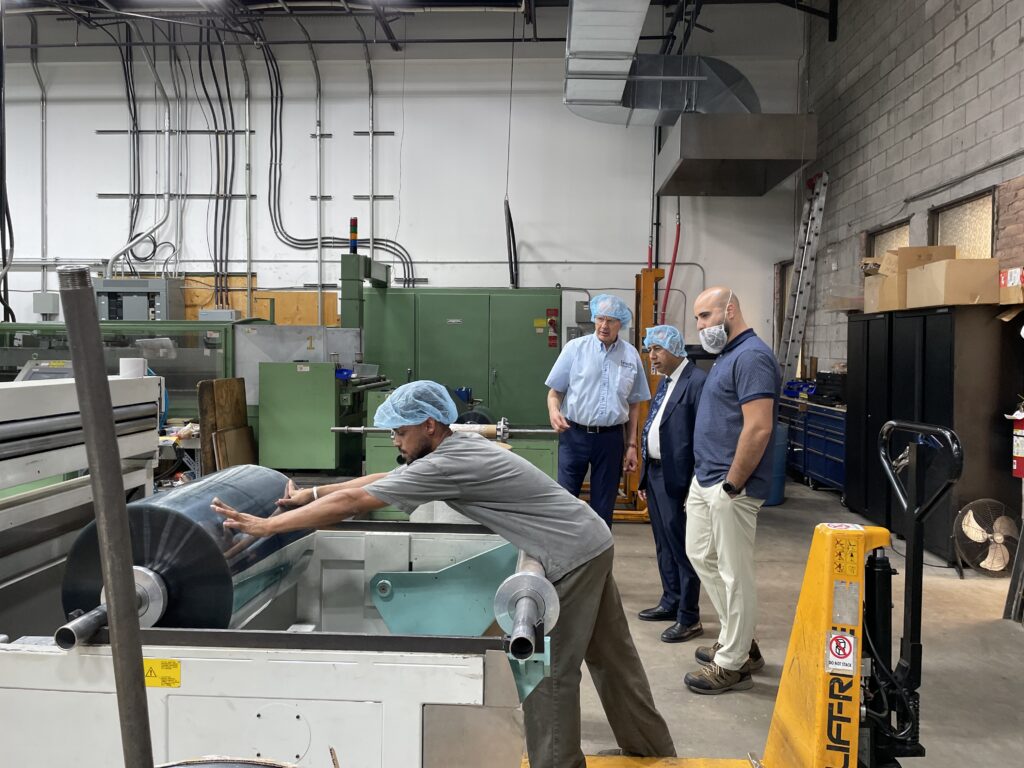
We are investing in new equipment that expands the capacity and capability of our existing thermoforming operation, so we can take on larger, more demanding programs. This is not a reaction to being at capacity today. It is a deliberate step in a longer plan, and we are investing now so we are ready for what our customers build next.
For a customer evaluating us as a partner, that translates into a few practical things. More room to scale a program without renegotiating priority. Steadier lead times as your volumes grow instead of the slow drift described above. A partner equipped to support an ambitious launch from prototype through full production, not just the first few thousand units.
New Equipment Only Solves Capacity If It Is Commissioned Right
Adding new equipment does not automatically fix a capacity question. Equipment that gets bolted in and rushed into production brings its own learning curve with it, and that curve gets paid for in scrap, downtime, and inconsistent parts right when a partner needs to be at their most reliable. When equipment is commissioned casually, it behaves unpredictably for months. Equipment that is commissioned to a high standard from day one behaves predictably from the first shift.
That difference comes down to detailed work most customers never see. Tool ventilation, temperature profiles, material behaviour under the specific tooling in front of you. Get those details right at commissioning, and the process becomes repeatable and reliable. Skip that step to save time, and you are trading a short-term schedule win for months of instability.

Bringing In Outside Expertise
As we bring this new equipment online, we are working with Andreas Dobringer of DTC, Dobringer Thermoforming Consulting, based in Austria. Andreas started in thermoforming in 1997 as a plastics technician, and over nearly 30 years he has collaborated closely with machine builders including ILLIG and KIEFEL and supported production operations at more than 20 locations around the world, including the United States, India, Russia, and Europe.
His view, shaped early on by his own mentor, is that thermoforming is not rocket science. Get the details right, and the process becomes repeatable, efficient, and reliable. That is the same standard we hold ourselves to, which is why his guidance is part of how we are commissioning this equipment rather than something we bolted on afterward.
Bringing in expertise like this is not a one-time favour. It is part of how a manufacturer grows responsibly. New equipment is only as good as the knowledge behind it, and backing the equipment with that knowledge from day one is what keeps a growing operation predictable instead of shaky.
What This Means for Your Next Program
Elmes has produced custom thermoformed packaging in Mississauga, Ontario since 1975, and this investment sits on top of that foundation rather than replacing it. Our ISO 9001:2015 and FSSC 22000 certifications still govern how every run is managed, we still deliver functional prototypes in 2 to 3 weeks, and we still work with customers from initial quoting through fulfillment. What changes is how much we can take on, and how confidently we can commit to a schedule while we do it.
A partner worth building a program around is one that is thinking about your growth before you have to ask them to.
Learn more about how we work, or get a quote to talk through your next launch.